
Saudi Working Hours, Breaks & Annual Leave
يوضح هذا الدليل أهم ساعات العمل وفترات الراحة والإجازات السنوية في السعودية وفق المعلومات واللوائح المنشورة من وزارة الموارد البشرية والتنمية الاجتماعية. يشمل الدليل ساعات العمل اليومية والأسبوعية، تخفيض ساعات العمل خلال رمضان للمسلمين، فترات الراحة، الراحة الأسبوعية، الإجازة السنوية، الإجازات الرسمية، والعمل خلال العطلات. إذا كنت تعمل في السعودية وتريد معرفة حقوقك المتعلقة بوقت العمل والإجازات، فهذا الدليل يساعدك على فهم القواعد والخطوات العملية بطريقة واضحة.
Quick Answer
For workers covered by the Saudi Labor Law, the general limit is 8 actual working hours per day or 48 hours per week, depending on the working-hours standard adopted by the employer. During Ramadan, actual working hours for Muslim workers are reduced to 6 hours per day or 36 hours per week.
A worker should not work more than five consecutive hours without a break of at least 30 minutes. The general weekly rest day is Friday, although it can be replaced for some workers in accordance with the law. Annual leave is at least 21 days per year, increasing to at least 30 days after five consecutive years with the employer.
Who Is This Guide For?
This guide is intended mainly for employees working under the Saudi Labor Law, especially private-sector workers who want a practical explanation of working hours, breaks, weekly rest and annual leave.
Domestic workers follow a separate regulatory framework. Their working hours, weekly rest and leave rules should be checked through the Ministry’s domestic-worker regulations rather than automatically applying the rules in this article.
Saudi Working Hours at a Glance
Hours Per Day
General daily standard for actual working hours.
Hours Per Week
General weekly standard where the weekly standard is adopted.
Ramadan Daily Hours
For Muslim workers during Ramadan.
Ramadan Weekly Hours
For Muslim workers during Ramadan.
How Many Hours Can You Work in Saudi Arabia?
Article 98 of the Saudi Labor Law provides that a worker may not be actually employed for more than 8 hours per day when the employer adopts the daily standard, or more than 48 hours per week when the weekly standard is adopted.
Daily Standard
Up to 8 actual working hours per day under the general rule.
Weekly Standard
Up to 48 actual working hours per week under the general rule.
These are general limits, not a statement that every employee must work exactly eight hours every day. The employment contract, work schedule and applicable regulations determine the worker’s actual schedule.
Are There Exceptions to the 8-Hour Working Day?
Yes. Article 99 allows working hours to be increased to 9 hours per day for certain categories of workers or industries where work is not continuous. Working hours may also be reduced to 7 hours per day for certain categories or hazardous or harmful work. The applicable categories are determined by ministerial decision.
Shift-based establishments can also have specific arrangements with Ministry approval, provided the applicable average working-hour limits are respected over the permitted reference period.
Saudi Working Hours During Ramadan
During Ramadan, actual working hours are reduced for Muslim workers to no more than 6 hours per day or 36 hours per week.
General Rule
8 hours/day 48 hours/weekRamadan for Muslim Workers
6 hours/day 36 hours/weekThe Ramadan reduction applies to actual working hours. Employers should organize schedules and rest periods consistently with the applicable Labor Law rules.
Breaks and Rest Periods in Saudi Arabia
A worker should not work for more than 5 consecutive hours without a break for rest, prayer and meals of at least 30 minutes at a time during the total working hours.
Maximum Consecutive Work
No more than five consecutive hours without the required break.
Minimum Break
The break should be at least 30 minutes at a time.
Workplace Presence
The general rule limits remaining at the workplace to 12 hours in a day.
Does the Break Count as Working Hours?
No. Rest, prayer and meal periods are not included in actual working hours. During these periods, the worker is not under the employer’s authority and the employer may not require the worker to remain at the workplace during the break.
Weekly Rest Day in Saudi Arabia
Friday is the weekly rest day for workers under the general Labor Law rule. The employer may, after notifying the competent Labor Office, substitute Friday with another day of the week for some workers, while enabling them to perform their religious obligations.
The weekly rest day is with full pay and must not be less than 24 consecutive hours.
Weekly Rest Is Not Simply a Cash Payment
The Labor Law states that the weekly rest day may not be compensated by a monetary payment instead of providing the required rest.
Can Your Weekly Rest Day Be Changed From Friday?
In some work arrangements, yes. The employer may replace Friday with another day for some workers after notifying the competent Labor Office and must enable workers to perform their religious obligations.
This does not mean an employer can simply remove the weekly rest entitlement. The replacement day must still satisfy the applicable weekly-rest requirements.
Annual Leave in Saudi Arabia
A worker is entitled to annual leave of at least 21 days for each year. This increases to at least 30 days if the worker has spent five consecutive years in the service of the employer.
Days Per Year
Minimum annual leave entitlement.
Days After 5 Years
Minimum annual leave after five consecutive years with the employer.
Annual leave is paid in advance. Workers should check their employment records and leave balance to make sure leave is properly recorded.
Can an Employer Refuse or Cancel Annual Leave?
The Labor Law allows the employer to set annual-leave dates according to work requirements or grant leave on a rotating basis to maintain the operation of the workplace. The worker should receive sufficient notice of the scheduled leave date, with the Labor Law specifying notice of at least 30 days in the relevant provision.
The employer’s ability to schedule leave does not remove the worker’s underlying annual-leave entitlement.
Can You Give Up Annual Leave or Take Cash Instead?
During employment, a worker may not simply waive the annual leave entitlement or receive cash instead of taking the leave. The Labor Law requires the worker to enjoy the leave in the year in which it becomes due, subject to the rules governing scheduling and postponement.
What Happens to Unused Annual Leave When You Leave Your Job?
If the employment relationship ends and the worker has accrued annual-leave days that were not used, the worker is entitled to the wage for those accrued days. The worker can also be entitled to leave pay for the portion of a year worked, according to the applicable rules.
Saudi Public Holidays and Official Leave
The Labor Law provides paid leave for official holidays and occasions specified by the implementing regulations. HRSD’s published guidance lists the principal Eid and National Day rules and explains how overlapping holidays are handled.
Eid Al-Fitr
Four days under the published Labor Law holiday guidance.
Eid Al-Adha
Four days under the published Labor Law holiday guidance.
Saudi National Day
One paid official holiday under the applicable rules.
Founding Day
A separate official holiday under the applicable Saudi regulations.
What If a Public Holiday Overlaps With Your Leave?
HRSD’s published holiday guidance addresses overlaps with weekly rest and annual leave. When an official holiday overlaps with a weekly rest day, compensation is provided according to the applicable rule. When it overlaps with annual leave, the annual leave is extended by the number of holiday days covered by the rule.
Holiday treatment can depend on the specific type of leave and the date involved, so workers should check the current official rules for their particular situation.
Working on Public Holidays and Official Vacations
Working hours performed during holidays and official vacations are considered overtime under Article 107. The applicable overtime compensation rules therefore become relevant when a worker is required to work during those periods.
With the worker’s consent, paid compensatory leave may be provided instead of overtime wages, subject to the applicable regulations.
Other Paid Leave Workers Should Know About
Annual leave is only one category of leave under the Saudi Labor Law. The law also provides paid leave for certain personal and family events and other circumstances, subject to their specific conditions.
Marriage
The Labor Law provides paid leave for qualifying marriage circumstances.
Bereavement
Paid leave is available for specified family-death circumstances.
Birth of a Child
The law provides paid leave connected with the birth of a worker’s child.
These leave categories have specific conditions and should not be confused with the worker’s annual-leave entitlement.
What Workers Should Check in Their Work Schedule
What Should You Keep as Proof?
Keeping these records is useful if your actual working schedule, leave balance or overtime payment later becomes disputed.
Saudi Working Hours, Breaks & Annual Leave Infographic
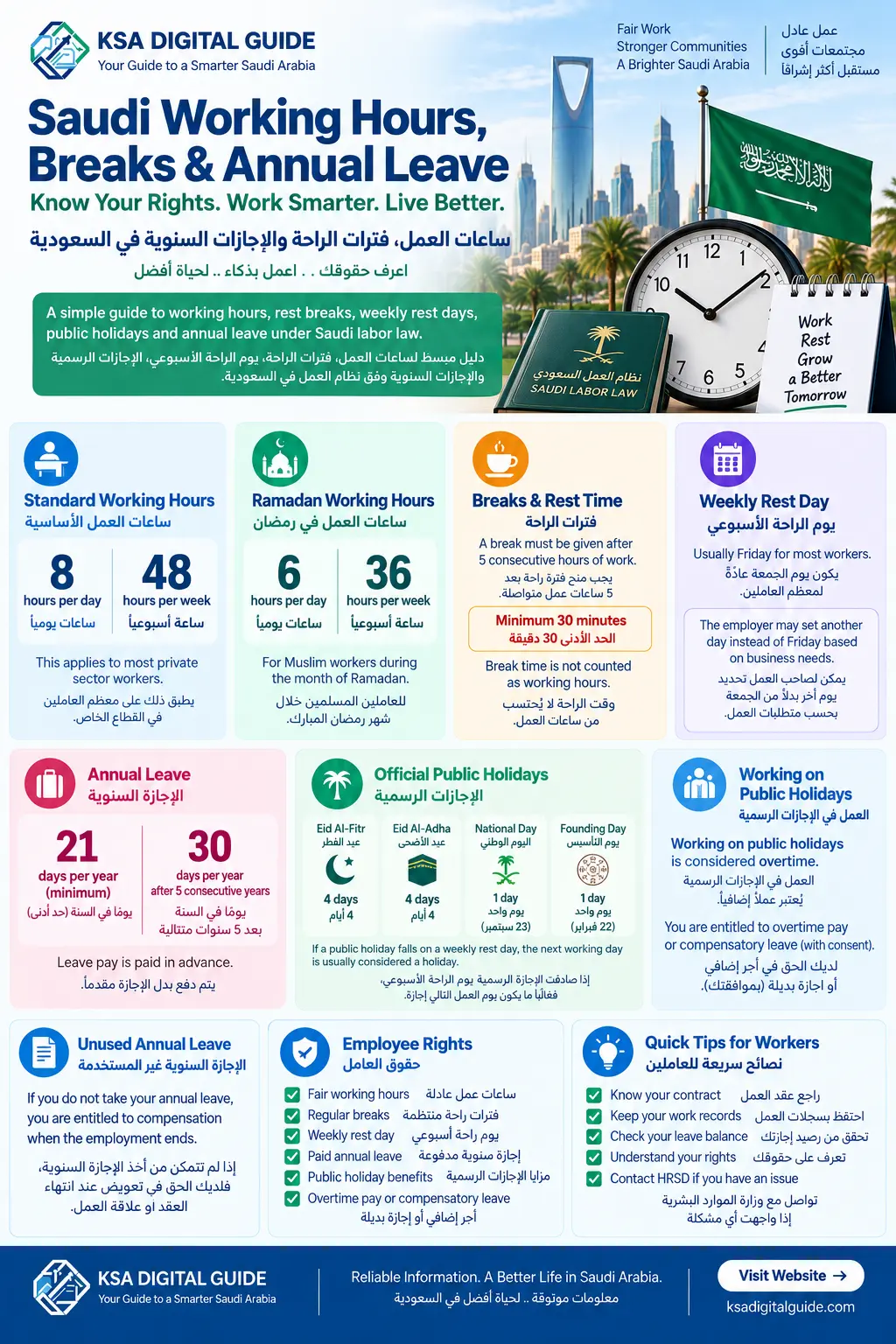
Saudi Working Hours & Leave Checklist
Working Hours & Leave Rules at a Glance
| Topic | General Rule |
|---|---|
| Daily working hours | Up to 8 actual hours under the general daily standard |
| Weekly working hours | Up to 48 actual hours under the general weekly standard |
| Ramadan | Muslim workers: up to 6 hours/day or 36 hours/week |
| Break | At least 30 minutes after no more than 5 consecutive working hours |
| Weekly rest | Friday under the general rule; at least 24 consecutive hours |
| Annual leave | At least 21 days per year |
| After 5 consecutive years | Annual leave increases to at least 30 days |
| Annual leave pay | Paid in advance |
| Unused accrued leave at end of employment | Worker is entitled to the wage for accrued unused leave under the applicable rule |
| Holiday work | Working hours during holidays and official vacations are overtime |
Frequently Asked Questions
How many hours can an employee work per day in Saudi Arabia?
The general rule is no more than 8 actual working hours per day when the employer adopts the daily standard, subject to applicable exceptions.
How many working hours are allowed per week in Saudi Arabia?
The general weekly standard is no more than 48 actual working hours per week, subject to the applicable rules and exceptions.
What are Ramadan working hours in Saudi Arabia?
During Ramadan, actual working hours for Muslim workers are reduced to no more than 6 hours per day or 36 hours per week.
How long should a work break be in Saudi Arabia?
A worker should not work more than five consecutive hours without a break of at least 30 minutes for rest, prayer and meals.
Is Friday the weekly rest day in Saudi Arabia?
Friday is the weekly rest day under the general Labor Law rule, but the employer may replace it for some workers with another day after the required notification and while enabling religious obligations.
How many annual leave days do workers get in Saudi Arabia?
Workers are entitled to at least 21 days of annual leave each year. The entitlement increases to at least 30 days after five consecutive years with the employer.
Is annual leave paid in Saudi Arabia?
Yes. The Labor Law provides that annual leave is paid in advance.
Can unused annual leave be paid in cash?
During employment, a worker may not simply waive annual leave or take cash instead of enjoying the leave. When employment ends, accrued unused leave is payable according to the applicable rule.
Is working on a public holiday considered overtime?
Yes. Article 107 provides that working hours performed during holidays and official vacations are considered overtime hours.
Do domestic workers follow the same working-hour rules?
No. Domestic workers are covered by separate regulations. Their working hours, rest and leave should be checked under the Ministry’s domestic-worker framework.
Official Sources
Know Your Working-Time & Leave Rights
Keep your schedule, leave balance, approvals and overtime records organized. If something does not match your employment records, use the official labor channels and current HRSD rules to check your rights.
Explore the Saudi Worker Rights Guide →