
Saudi End of Service Benefit Guide
Understand Saudi end of service benefit rules, how the gratuity is calculated, what happens after resignation, and how to check your expected entitlement using the official HRSD calculator.
مكافأة نهاية الخدمة في السعودية
يوضح هذا الدليل أهم قواعد مكافأة نهاية الخدمة في السعودية وفق المعلومات المنشورة من وزارة الموارد البشرية والتنمية الاجتماعية ونظام العمل السعودي. يشرح الدليل طريقة الحساب، أساس الأجر المستخدم، استحقاق العامل عند الاستقالة، الحالات الخاصة، تسوية المستحقات عند انتهاء العلاقة التعاقدية، وكيفية استخدام حاسبة مكافأة نهاية الخدمة الرسمية. إذا كنت تعمل في السعودية وتريد معرفة ما قد تستحقه عند انتهاء عملك، فهذا الدليل يساعدك على فهم القواعد والخطوات الرسمية دون الاعتماد على تخمينات أو حسابات غير موثوقة.
Quick Answer: What Is the Saudi End of Service Benefit?
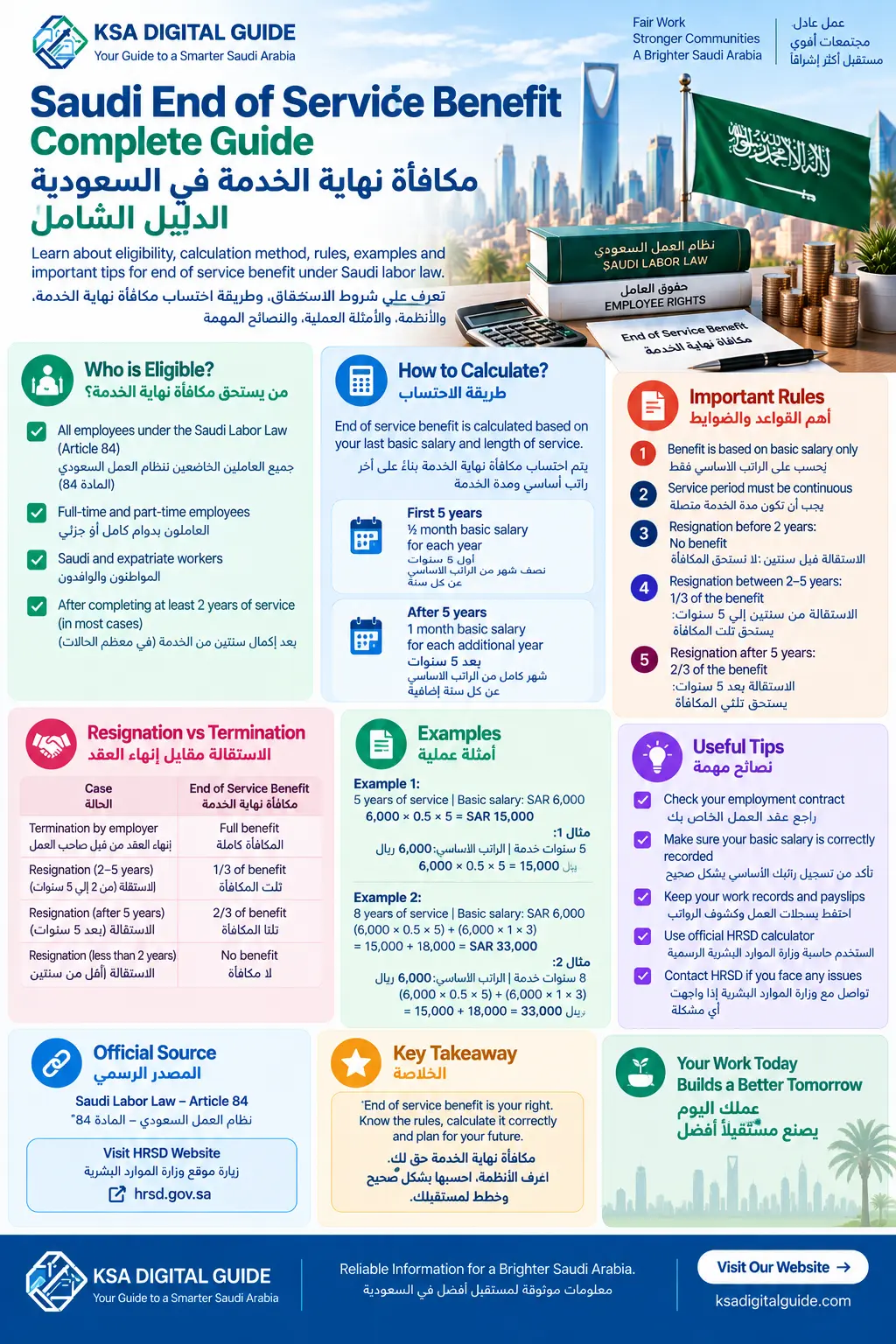
The Saudi end of service benefit is a statutory employment entitlement paid when an employment relationship ends, subject to the applicable Labor Law rules. Under Article 84, the general award is based on half a month’s wage for each of the first five years and one month’s wage for each following year, with partial years calculated proportionally. The last wage received is the basis under Article 84.
Resignation has separate rules under Article 85. Depending on continuous service, the worker may receive one-third, two-thirds, or the full calculated award. Certain exceptional situations can provide the full award even when the normal resignation rules would otherwise apply.
Who Is This Guide For?
This guide is designed for employees and workers who want to understand their end of service entitlement when their employment relationship ends. It is especially useful for Saudi and expatriate workers covered by the Saudi Labor Law who are checking a final settlement, considering resignation, completing a fixed-term contract, or reviewing an employer’s calculation.
Saudi End of Service Benefit at a Glance
First 5 Years
Half a month’s wage for each year of service.
After 5 Years
One month’s wage for each following year.
Partial Years
Fractions of a year are calculated proportionally to the period worked.
Last Wage
Article 84 states that the last wage received is the basis for the award.
Resignation
Articles 85 and 87 contain special rules for resignation and exceptional cases.
Final Settlement
Article 88 sets a maximum settlement period after the employment relationship ends.
How Is End of Service Benefit Calculated in Saudi Arabia?
The basic statutory structure comes from Article 84 of the Saudi Labor Law. The calculation uses the worker’s last wage as the basis and divides service into two main periods.
When the service period includes a fraction of a year, the worker is entitled to a proportionate amount for that part of the year. This means a worker does not need to complete another full year for the additional period to be considered.
What Wage Is Used for the Calculation?
This is one of the most important parts of the calculation. HRSD’s Labor Law definitions distinguish between basic salary and actual wage. The actual wage can include the basic wage plus other due increases connected with the work or provided under the employment contract or work regulations.
Article 84 states that the last wage received is the basis for the end-of-service award. HRSD’s end-of-service guidance also explains that the award is calculated using the last wage.
However, Article 86 allows an agreement under which some or all commissions, sales percentages and similar wage elements that naturally increase or decrease are not included in the wage used for the award. This is why checking the actual contractual wage structure matters.
Saudi End of Service Benefit Examples
The following examples demonstrate the Article 84 structure. They are illustrations, not a replacement for the official HRSD calculator or a case-specific legal determination.
Example 1: 3 Years of Service
Last wage: SAR 6,000
3 × 0.5 × 6,000 = SAR 9,000
Example 2: 5 Years of Service
Last wage: SAR 6,000
5 × 0.5 × 6,000 = SAR 15,000
Example 3: 8 Years of Service
Last wage: SAR 6,000
(5 × 0.5 × 6,000) + (3 × 6,000) = SAR 33,000
Example 4: 10 Years of Service
Last wage: SAR 6,000
(5 × 0.5 × 6,000) + (5 × 6,000) = SAR 45,000
What Happens to End of Service Benefit After Resignation?
Resignation is treated differently from a general termination under Article 85. The worker’s entitlement depends on the continuous service period.
| Continuous service | Resignation entitlement |
|---|---|
| Less than 2 years | No end-of-service award under the ordinary Article 85 resignation rule. |
| 2 to 5 years | One-third of the calculated award. |
| More than 5 and less than 10 years | Two-thirds of the calculated award. |
| 10 years or more | Full calculated award. |
These thresholds refer to the continuous service periods stated in Article 85. The exact legal treatment of the termination should be checked against the actual circumstances and contract.
When Can a Worker Receive the Full Benefit Despite Resignation?
Article 87 creates exceptions to the normal resignation reduction. A worker is entitled to the full end-of-service award when leaving work because of a force majeure beyond the worker’s control.
The same article provides a specific full-award rule for a female worker who terminates the contract within six months from the date of marriage or within three months from the date of giving birth.
Does the Reason for Leaving the Job Matter?
Yes. The way the employment relationship ends can affect the worker’s entitlement. Article 84 establishes the general award, Article 85 addresses resignation, and Article 87 provides exceptional full-award situations.
Other Labor Law provisions also govern termination, notice, compensation and situations in which a worker may leave without notice while retaining statutory rights. For example, Article 81 covers specific circumstances in which a worker can leave without notice while retaining statutory rights.
End of Service Benefit for Fixed-Term and Indefinite Contracts
The end-of-service award is not limited to one contract type. HRSD explains that the Labor Law makes the award applicable when the employment contract ends, subject to the rules governing the reason for termination. Fixed-term contracts also have specific rules on expiry and early termination.
If a fixed-term contract simply reaches its agreed expiry and the employment relationship ends, the general Article 84 calculation is relevant. If the contract is ended early, other Labor Law provisions may affect compensation and the final settlement.
For indefinite contracts, notice and termination rules under Articles 75–77 may also matter separately from the end-of-service award.
When Should the Employer Pay the Final Entitlements?
Article 88 provides a clear settlement timeline. When the employment relationship ends, the employer must pay wages and settle the worker’s entitlements within a maximum of one week from the end of the contractual relationship. If the worker is the one who terminated the contract, the employer must settle the worker’s entitlements within a period not exceeding two weeks.
The same article allows the employer to deduct a work-related debt owed by the worker from amounts due, subject to the applicable rules.
What Should You Check Before Accepting Your Final Settlement?
Check Your Last Wage
Review the wage shown in your employment records and identify the components that may form part of the wage used for the award.
Confirm Your Service Period
Check your start date, end date and any periods that affect continuous service.
Identify the Termination Reason
Determine whether the relationship ended by expiry, termination, resignation, agreement or another legally recognized reason.
Calculate the Article 84 Award
Apply the half-month rule for the first five years and the one-month rule for later years, including proportional fractions.
Apply Resignation Rules if Relevant
If you resigned, check the two-, five- and ten-year thresholds under Article 85 and any applicable exception under Article 87.
Check the Official Calculator
Use HRSD’s calculator with your actual wage, contract type, termination reason and service period as requested by the tool.
Use the Saudi End of Service Benefit Calculator
HRSD’s official calculator asks for actual wage, contract type, termination reason, and service years, months and days. It then provides an automated estimate.
Open Official HRSD Calculator →What Information Does the HRSD Calculator Ask For?
Actual Wage
Enter the actual wage requested by the official calculator.
Contract Type
Select the applicable contract type.
Termination Reason
Select the reason for ending the employment relationship.
Service Years
Enter completed service years.
Service Months
Add remaining service months when applicable.
Service Days
Add remaining service days when applicable.
HRSD states that the calculator operates automatically and that the Ministry is not responsible for the result produced by the calculator.
What If the Employer Does Not Pay the Correct Amount?
Start by comparing your final settlement with your employment records and the applicable Labor Law rules. Keep copies of your employment contract, wage records, service dates, resignation or termination documents and final settlement statement.
If there is an employment dispute that cannot be resolved directly, the Ministry’s Friendly Settlement for Labor Disputes is the first stage for eligible labor disputes. The service is electronic and free, and HRSD lists Arabic, English and Urdu among the available languages.
Documents and Records Workers Should Keep
- Employment contract and documented contract records
- Recent salary or wage records
- Start-date and service records
- Resignation, termination or contract-expiry documents
- Final settlement calculation or statement
- Relevant correspondence about the end of employment
- Copies of any complaint or dispute documents
Common Questions About Saudi End of Service Benefit
How is Saudi end of service benefit calculated?
Under Article 84, the general award is half a month’s wage for each of the first five years and one month’s wage for each following year, with partial years calculated proportionally. The last wage received is the basis stated in Article 84.
Do I get end of service benefit if I resign?
Resignation has special rules under Article 85. The ordinary entitlement is one-third after at least two and up to five years of continuous service, two-thirds when service exceeds five but is less than ten years, and the full award when service reaches ten years or more. Article 87 provides certain exceptions.
What happens if I worked less than two years and resigned?
Under the ordinary Article 85 resignation rule, a worker with less than two years of continuous service is not entitled to the end-of-service award.
Is the calculation based only on basic salary?
Not automatically. Article 84 refers to the last wage, and HRSD defines actual wage separately. Article 86 also allows certain variable commission or sales components to be excluded by agreement. Check the applicable wage components and contract.
Are partial years included?
Yes. Article 84 states that the worker is entitled to a proportional award for fractions of a year worked.
How long does the employer have to settle my rights?
Article 88 says the employer must settle wages and entitlements within one week after the contractual relationship ends, or within a period not exceeding two weeks when the worker is the one who terminated the contract.
Can I calculate my benefit online?
Yes. HRSD provides an official End of Service Benefit Calculator that asks for actual wage, contract type, termination reason and service years, months and days.
Do domestic workers use the same formula?
No. Domestic workers are excluded from the ordinary Labor Law provisions and are covered by separate regulations. HRSD currently states a different domestic-worker end-of-service formula.
Does a fixed-term contract affect end of service benefit?
The award is governed by the Labor Law rules, while fixed-term contracts have separate rules concerning expiry and early termination. The reason the relationship ends should be checked before calculating the final settlement.
What if my employer calculates a different amount?
Compare the calculation with your last wage, continuous service period and the legal reason for termination. If the issue cannot be resolved, eligible labor disputes can proceed through HRSD’s Friendly Settlement service.
Related KSA Digital Guide Resources
Official Sources
Saudi End of Service Benefit: Key Takeaways
- Article 84 uses half a month’s wage for each of the first five years.
- Each following year uses one month’s wage.
- Partial years are calculated proportionally.
- The last wage received is the Article 84 basis.
- Resignation can reduce the calculated award depending on continuous service.
- Article 87 contains specific full-award exceptions.
- Article 88 sets the final-settlement time limits.
- HRSD provides an official online calculator.
- Domestic workers follow separate rules.
Know Your Saudi Employment Rights
Save this guide, check your employment records, and use official HRSD services when you need to verify your end-of-service entitlement.
Calculate Your Benefit on HRSD →