
Saudi Job Transfer & Profession Change Guide
Learn how expatriate workers can transfer employment and how employers can request profession changes through the official Saudi labor-system services.

نقل خدمات العامل وتغيير المهنة في السعودية
يوضح هذا الدليل كيفية فهم نقل خدمات العامل وتغيير المهنة في السعودية وفق الخدمات المنشورة من وزارة الموارد البشرية والتنمية الاجتماعية. يشرح الدليل الفرق بين نقل الموظف إلى صاحب عمل جديد، ونقل الخدمات دون موافقة صاحب العمل الحالي وفق الضوابط، وتغيير مهنة العامل المقيم عبر منصة قوى. كما يوضح الفرق بين عمال القطاع الخاص والعمالة المنزلية، لأن نقل خدمات العمالة المنزلية يتم عبر منصة مساند وليس من خلال مسار نقل موظفي القطاع الخاص في قوى.
Quick Answer
Saudi job transfer and profession change are related but separate processes. For non-Saudi private-sector workers, employee-transfer services are provided through Qiwa, while the expatriate profession-change service is also handled through Qiwa and is normally an establishment-side request. Domestic-worker transfers follow separate Musaned services.
What Is Job Transfer in Saudi Arabia?
Job transfer means moving a non-Saudi employee’s employment services from one employer or establishment to another under the applicable Saudi labor-system process. HRSD currently lists Qiwa services for transferring expatriate employees and for transfers under the freedom-of-movement service, subject to the applicable rules.
The exact route depends on the worker’s situation. A new employer may submit an employee-transfer request through Qiwa, while a separate HRSD service allows a resident employee to transfer to a new employer without current-employer approval when the applicable service conditions are met.
Employee Transfer
A Qiwa service used by establishments to request the transfer of non-Saudi employees.
Freedom of Movement
A separate route for eligible resident employees to transfer without current-employer approval under applicable rules.
Profession Change
A separate Qiwa service for changing or correcting an expatriate employee’s profession.
Job Transfer Through Qiwa
HRSD’s current employee-transfer service allows an establishment to request the transfer of an expatriate employee from another employer. The establishment logs into its Qiwa account, selects the employee-transfer service, chooses the destination establishment, adds worker information and submits the request with an employment contract.
Employer logs in
The new employer uses the establishment’s Qiwa account.
Select transfer service
The employer selects the employee-transfer option in the available services.
Add worker details
The establishment enters the information of the employee whose services are being transferred.
Add the employment contract
The current HRSD service lists an employment contract for each worker as part of the request.
Submit the request
The establishment submits the transfer request through Qiwa for system processing.
System processing
The request is processed according to the applicable service requirements and establishment conditions.
Transfer Without Current Employer Approval
HRSD currently lists a Transfer of Services from Another Employer (Freedom of Movement) service. It allows a resident employee to move to a new employer without the current employer’s approval, subject to the applicable regulations and conditions.
The current process is described as follows: the new employer submits a job offer through Qiwa, the worker logs into the platform and accepts or rejects the offer, the existing employer is notified, and the system verifies the requirements. After approval, the worker’s data is updated and a new work permit is issued.
What Is Profession Change in Saudi Arabia?
Profession change is a separate service used to change or correct the profession of a resident employee so that the recorded profession matches the work performed, subject to Saudi occupational classification and applicable restrictions.
HRSD currently lists this service through Qiwa. The request is made by an authorized establishment representative rather than being presented as a normal worker-side self-service profession change.
How to Change an Expatriate Profession Through Qiwa
Open Qiwa
Log in to the Qiwa platform using the establishment account.
Select profession change
Choose the profession-change service from the available Qiwa services.
Check eligibility
The establishment and worker must meet the current service requirements.
Submit the request
Start and complete the electronic profession-change request through Qiwa.
Current Profession-Change Requirements
- The applicant should be an accredited representative of the establishment in HRSD systems.
- All establishment licenses must be valid.
- The establishment must be within the required Platinum or Green range listed by HRSD.
- The establishment status must be current.
- The requested profession cannot be a profession restricted to Saudi nationals.
- Where applicable, professional practice certification is required for regulated professions such as engineering, veterinary and accounting professions.
- The worker must not be in an “awaiting service transfer” status.
- There must not already be a profession-change request in progress for the same worker.
- The worker must not have been issued a final exit visa.
Job Transfer vs Profession Change
Regular Private-Sector Workers vs Domestic Workers
One of the most important distinctions is the worker category. The Qiwa employee-transfer and expatriate profession-change services discussed above relate to the applicable private-sector labor-system processes.
Domestic workers follow separate transfer services through Musaned. HRSD’s current domestic-worker transfer services include processes between individual employers and other domestic-worker transfer routes. Therefore, a domestic worker should not simply follow the private-sector Qiwa transfer steps in this guide.
Private-Sector Worker
Employee transfer and expatriate profession change use the applicable Qiwa/HRSD services.
Domestic Worker
Domestic-worker transfer services are handled through Musaned under separate rules.
Check Your Category
Use the service that matches your employment category before starting a transfer request.
What Should You Check Before a Job Transfer?
- Review the new employment offer and contract details carefully.
- Check that your personal and employment information is accurate.
- Confirm that the new employer is using the correct Qiwa transfer service.
- Check your current employment status and any pending transfer-related request.
- Keep copies of your employment contract and important employment records.
- Do not assume that a profession change and employer transfer are the same request.
What Should You Check Before a Profession Change?
- Confirm that the new profession matches the actual work being performed.
- Check whether the profession is subject to localization restrictions.
- Confirm that any required professional certificate is available.
- Make sure the establishment licenses and status meet the service requirements.
- Check that the worker is not awaiting a service transfer or another profession-change request.
- Make sure there is no final exit visa that prevents the requested change.
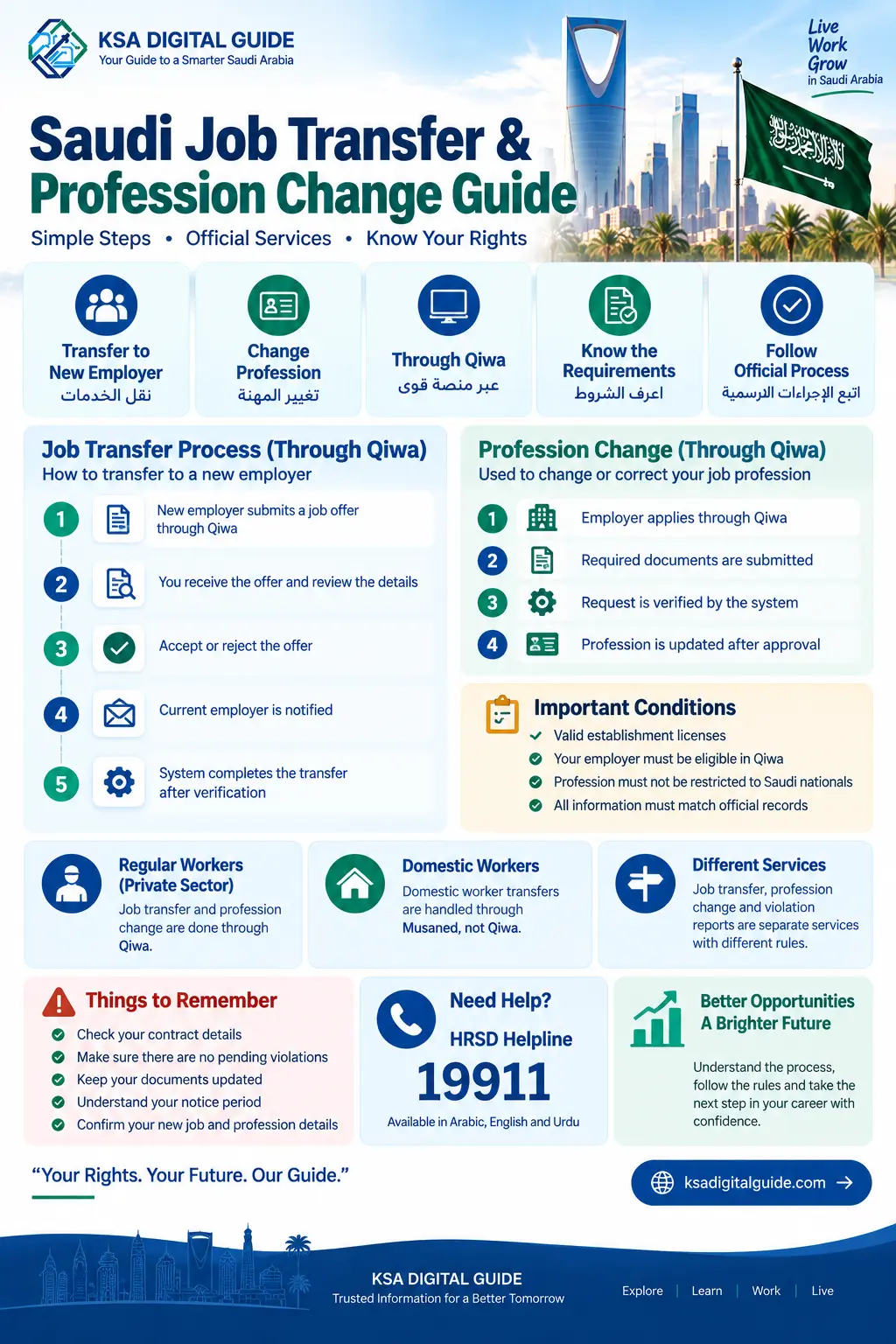
Saudi Job Transfer & Profession Change — Infographic
HRSD Support
HRSD Helpline
For HRSD labor-service support, workers can use the Ministry’s customer-service channel. Check the official HRSD service page for the latest service details and availability.
Frequently Asked Questions
Can an expatriate worker transfer to a new employer through Qiwa?
Yes. HRSD currently provides Qiwa-based employee-transfer services for applicable non-Saudi private-sector workers. The exact process and eligibility depend on the service route and current requirements.
Can a worker transfer without the current employer’s approval?
HRSD currently lists a freedom-of-movement service that allows an eligible resident employee to transfer to a new employer without current-employer approval, subject to the applicable regulations and conditions.
Can a worker change their profession themselves?
The current HRSD profession-change service is an establishment-side service through Qiwa. An authorized establishment representative submits the request.
Can an expatriate change to any profession?
No. HRSD states that an expatriate profession cannot be changed to a profession restricted to Saudi nationals. Other professional requirements may also apply.
Is profession change the same as job transfer?
No. Job transfer concerns moving employment services to another employer or establishment. Profession change concerns changing or correcting the recorded profession.
Do domestic workers use Qiwa for job transfer?
Domestic workers follow separate transfer services through Musaned. They should not use the private-sector Qiwa transfer process described for regular expatriate employees.
Is the profession-change service free?
HRSD’s current profession-change service page lists the service as free.
What happens after a freedom-of-movement transfer is approved?
HRSD states that after the system verifies the requirements and the request is approved, the worker’s data is updated and a new work permit is issued.
Related KSA Digital Guide Resources
Official Sources
- HRSD — Request for Transfer of Expatriate Workers
- HRSD — Transfer of Services from Another Employer (Freedom of Movement)
- HRSD — Change Expatriate Profession
- HRSD — Domestic Labor Transfer through Musaned
Key Takeaways
- Job transfer and profession change are separate processes.
- Applicable private-sector expatriate transfer services are provided through Qiwa.
- HRSD currently lists a freedom-of-movement route for eligible resident employees without current-employer approval, subject to the applicable rules.
- Profession change is an establishment-side Qiwa service with specific eligibility requirements.
- Domestic-worker transfers are handled through Musaned under separate rules.
- Always check the current HRSD service requirements before submitting a request.
Need More Saudi Worker Guidance?
Explore our practical guides covering worker rights, salaries, leave, end-of-service benefits and labor complaints in Saudi Arabia.
Explore Worker Rights Guides →