
Saudi Salary Payment & Overtime Rules
حقوق الرواتب والعمل الإضافي في السعودية من أهم حقوق العامل التي يجب معرفتها. يوضح هذا الدليل حقوق العامل في الراتب والعمل الإضافي وفق المعلومات واللوائح المنشورة من وزارة الموارد البشرية والتنمية الاجتماعية، بما في ذلك مواعيد دفع الأجور، أنواع الأجور، العمل الإضافي، الخصومات، البدلات، ونظام حماية الأجور. إذا كنت تعمل في السعودية وتريد معرفة ما يجب أن تعرفه عن راتبك أو مستحقات ساعات العمل الإضافية، فهذا الدليل يساعدك على فهم القواعد والخطوات الرسمية المتاحة عند وجود مشكلة.
Quick Answer
Under Saudi Labor Law, workers have rules governing when wages must be paid, how wages are paid, what deductions are permitted and how overtime compensation is calculated.
For monthly-paid workers, wages are generally paid once a month. Saudi Labor Law also provides additional compensation for overtime equal to the hourly wage plus 50% of the basic wage.
What Does Salary Mean Under Saudi Labor Law?
It is important to understand the difference between basic wage and actual wage.
The basic wage is the amount paid to the worker for work under the employment contract, including applicable periodic increases. The actual wage can include the basic wage plus additional amounts due to the worker, such as applicable commissions, allowances, increases, rewards and in-kind benefits depending on the employment arrangement.
Basic Wage
Core wage paid for the work under the employment contract.
Actual Wage
Basic wage plus applicable additional amounts due to the worker.
Allowance
An additional payment provided under the contract, work rules or applicable entitlement.
Overtime
Additional compensation for qualifying hours worked beyond the applicable standard.
Saudi Salary Payment Rules
Saudi Labor Law sets payment intervals for different types of workers.
Monthly-Paid Workers
Workers receiving monthly wages should receive their wages once every month.
Daily-Paid Workers
Daily-paid workers must receive their wages at least once a week.
Piecework
Where piecework requires more than two weeks to complete, weekly payments may apply according to the portion of work completed and the applicable rules.
Other Wage Arrangements
Other arrangements are subject to the applicable wage-payment rules and the employment relationship.
How Should Salary Be Paid in Saudi Arabia?
Workers’ wages should be paid in the official currency and through approved banking channels in the Kingdom, according to the applicable payment date and employment arrangement.
What Is the Wage Protection System in Saudi Arabia?
The Wage Protection System (WPS) is an HRSD program used to monitor wage payments in the private sector. It helps improve transparency around wage payments and the contractual employment relationship.
For workers, WPS is important because salary payment is monitored through the labor system rather than being only a private arrangement between the employee and employer.
Saudi Overtime Rules
Overtime is one of the most important parts of this guide. Under Article 107, the employer must pay additional compensation for overtime equal to:
The employer may, with the worker’s consent, provide paid compensatory leave instead of overtime wages, subject to the applicable regulations.
Simple Example
Suppose a worker’s applicable hourly wage is SAR 20 and the basic hourly wage is SAR 20.
SAR 20 + 50% of SAR 20 = SAR 30
The actual calculation should be based on the worker’s applicable wage structure and employment circumstances.
When Is Work Considered Overtime?
When an establishment uses a weekly working-hours standard, hours exceeding the applicable standard can be considered overtime.
Working hours performed on public holidays and official vacations are also treated as overtime under the applicable rules.
Can an Employer Give Compensatory Leave Instead of Overtime Pay?
Yes. Saudi Labor Law allows the employer, with the worker’s consent, to provide paid compensatory leave instead of overtime wages, subject to the applicable regulations.
Is There a Limit on Overtime Hours?
HRSD’s published overtime guidance states that additional working hours during the year may not exceed 720 hours, while the worker’s consent can allow additional hours beyond that limit under the applicable rules.
Overtime should also be considered together with the rules governing maximum working hours and special categories of work.
For broader working-hours rules, see our Saudi Working Hours, Breaks & Annual Leave Guide .
Salary Deductions in Saudi Arabia
An employer cannot simply deduct any amount from a worker’s salary whenever they want. Saudi Labor Law establishes specific situations in which deductions may be made.
Loans
Certain employer loans may be recovered through salary deductions within the applicable limits.
Legal Contributions
Some legally required contributions may be deducted where applicable.
Other Permitted Amounts
Other deductions may apply only where permitted by law and subject to the relevant conditions.
How Much Can Be Deducted From Salary?
As a general rule, total deductions should not exceed half of the worker’s due wage, subject to the exceptions and conditions provided by law.
Particular types of deductions can have their own percentage limits. For example, repayment of an employer loan through salary deduction should not exceed 10% of the worker’s wage under the applicable rule.
What If Your Employer Deducts Money Without a Valid Reason?
If money is deducted outside the situations allowed by law and without the required basis or consent, or wages are delayed without legitimate justification, workers can use the applicable labor-dispute mechanisms to seek recovery of unpaid amounts.
- Keep your employment contract.
- Save payslips and bank statements.
- Record overtime and attendance.
- Keep written communication with the employer.
- Keep any document explaining the deduction.
What If Your Salary Is Delayed?
Check Your Contract
Confirm salary, payment date, allowances, overtime terms and authorized deductions.
Check Your Bank Account
Keep evidence of the date the salary was actually deposited.
Ask the Employer or HR
Use a written message or email so there is a record of the issue.
Keep Evidence
Save payslips, bank records, attendance records and overtime evidence.
Use Official Labor Channels
If the matter remains unresolved, use the applicable HRSD labor-dispute channels.
How to File a Salary Complaint in Saudi Arabia
For an employment dispute with a private-sector employer, Friendly Settlement for Labor Disputes is the first stage of the labor-dispute process for eligible claims.
HRSD states that the service allows the parties to attempt negotiation and mediation. If the dispute cannot be settled, it can proceed according to the applicable labor-dispute procedure.
View HRSD Friendly Settlement Service →What Documents Should You Keep for a Salary Dispute?
What About a Documented Employment Contract?
A documented employment contract can become particularly important when dealing with unpaid wages. HRSD has an initiative concerning certain documented employment contracts that may qualify as enforceable instruments under the stated conditions.
Eligibility depends on the contract and the requirements of the applicable initiative, so workers should check the current official requirements rather than assuming every employment contract qualifies.
For more on documented contracts, see our Qiwa Employment Contract Guide .
Salary, Allowances and Deductions: What Should You Check?
Basic Salary
Check that the basic wage matches your documented employment terms.
Allowances
Review housing, transportation and other applicable contractual payments.
Overtime
Compare recorded overtime hours with the amount actually paid.
Deductions
Ask about unfamiliar deductions and check their legal or contractual basis.
Net Salary
Compare the final amount deposited into your bank account with your payslip.
Common Salary Problems in Saudi Arabia
Salary Paid Late
The employer does not pay the wage on the applicable due date.
Salary Partially Paid
Only part of the agreed wage is deposited.
Overtime Not Paid
Extra qualifying working hours are not properly compensated.
Unexplained Deduction
Money is deducted without a clear contractual or legal basis.
Incorrect Overtime Calculation
The payment does not match the applicable overtime rule.
Salary Does Not Match Contract
The amount paid differs from the documented employment terms.
Saudi Salary Payment & Overtime Infographic
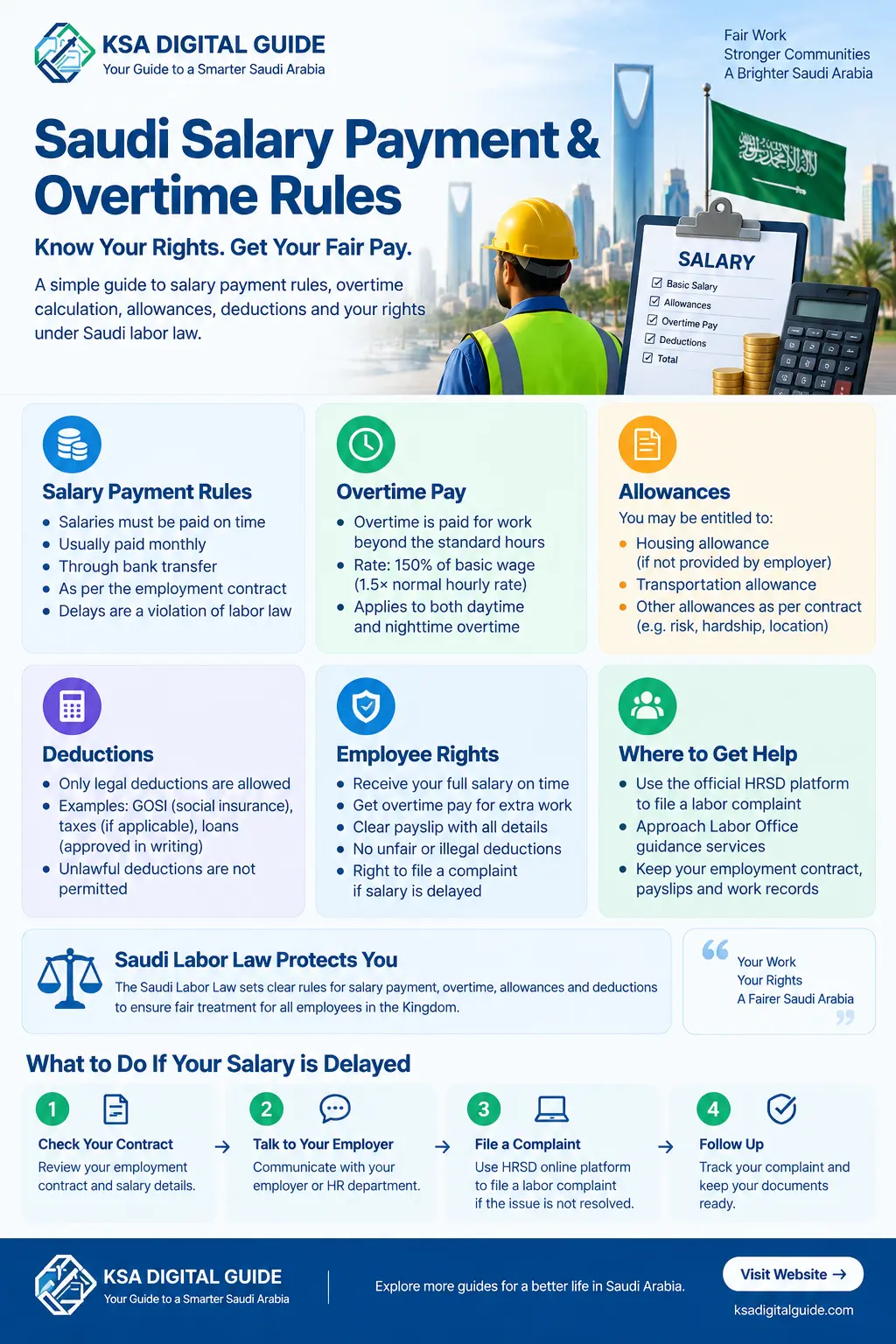
Saudi Salary Payment & Overtime Checklist
Salary & Overtime: Key Rules at a Glance
| Topic | Key Point |
|---|---|
| Monthly salary | Generally paid once a month |
| Daily wages | At least once a week |
| Bank payment | Approved banking channels are used for wage payment |
| Overtime | Hourly wage + 50% of basic wage |
| Public holidays | Working hours on public holidays are treated as overtime under the applicable rules |
| Compensatory leave | Possible with worker consent and applicable rules |
| Salary deductions | Only permitted categories and limits apply |
| WPS | Monitors private-sector wage-payment compliance |
| Labor dispute | Friendly Settlement is the initial stage for eligible labor disputes |
Frequently Asked Questions
When should monthly salary be paid in Saudi Arabia?
Monthly-paid workers are generally paid once a month under the applicable Labor Law rules.
How is overtime calculated in Saudi Arabia?
The additional overtime compensation is the hourly wage plus 50% of the basic wage.
Is work on a public holiday overtime?
Working hours performed on public holidays and official vacations are treated as overtime under the applicable rules.
Can an employer deduct money from my salary?
Only deductions falling within the categories and conditions established by Saudi Labor Law are permitted.
Can I receive paid leave instead of overtime pay?
Paid compensatory leave may be provided instead of overtime wages with the worker’s consent and subject to applicable regulations.
What should I do if my salary is delayed?
Check your contract and payment records, keep evidence, communicate with the employer in writing and use the applicable HRSD labor-dispute channels if the matter remains unresolved.
Where can I file a labor complaint?
Eligible private-sector workers can use HRSD’s Friendly Settlement for Labor Disputes service as the first stage of the labor-dispute process.
Does this guide apply to domestic workers?
Not in the same way. Domestic workers are governed by separate regulations and services, so their salary rules and complaint procedures should be checked through the applicable domestic-worker system.
Official Sources
Know Your Salary Rights
Keep your contract, salary records and overtime evidence organized. If a workplace issue remains unresolved, use the official labor channels available to you.
Explore the Saudi Worker Rights Guide →